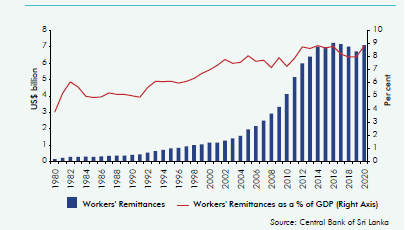
The importance of workers’ remittance inflows as a non-debt creating source of foreign exchange has increased in the face of the pandemic and the Central Bank has pointed out the need for immediate actions to keep remittances flowing.
Further, the CB has pointed out in contrast to capital flows which tend to be cyclical, remittances are relatively stable and often consumption smoothing, acting as insurance during economic crises. In 2020, the increase in workers’ remittances helped abate the impact of the sharp decline in tourist earnings.
Workers’ remittances have been the largest single source of foreign exchange inflow in Sri Lanka’s balance of payments (BOP) over the past decade.
Being a major source of financing the trade deficit, workers’ remittances have covered around 80 per cent of the annual trade deficit on average, over the past two decades and remittance inflow has exceeded the trade deficit in 2020 accounting for around 118 per cent of the trade deficit.
Workers’ remittances as a percentage of GDP, which averaged around 5.7 per cent during 1981-2000 period, increased to around 8.0 per cent of GDP during the period from 2001-2020, reflecting the increased importance of workers’ remittances in relation to Sri Lanka’s GDP.
Nevertheless, remittances have shown a declining trend during the past six years, except for 2016 and 2020. In the second half of 2020, workers’ remittances increased significantly and recorded the highest monthly remittances in the history in December 2020. Accordingly, during 2020, workers’ remittances increased by 5.8 per cent, year-on-year, to US dollars 7.1 billion.
Sri Lanka’s regional peers, i.e. Bangladesh and Pakistan have also started to demonstrate a partial recovery in remittances since the third quarter of 2020.
While India is the highest remittance recipient in the world with US dollars 83 billion recorded in 2019, China, Philippines, Pakistan, Bangladesh and Vietnam are also amongst the top ten nations receiving remittances (World Bank,2019).
Although Sri Lanka is behind its regional peers in South and South East Asia in terms of nominal inward remittances, Sri Lanka’s performance of workers’ remittances in relation to GDP places it amongst the top five remittance recipients in the two regions.
However, the housemaids category, which accounted for the largest share of annual migrations of over 50 per cent two decades ago, has declined drastically to a share of below 30 per cent by 2020. In contrast, the share of labour migration under professional and skilled employee categories combined has almost doubled from 21 per cent to 37 per cent during the same period.
Even though an upward trend in skilled labour migration can be witnessed, there exists a large mismatch between the international demand for jobs and Sri Lanka’s supply capabilities, the Central Bank has pointed out.
A higher demand is generated in advanced economies for specialised services such as nursing and elderly care with the changes in demographics including population ageing and increased female labour force participation rates.
These jobs have a relatively high earning potential than in the case of housemaids. However, Sri Lanka has limited training institutions with international accreditation, recognised by foreign employers, to provide job-oriented training to bridge the skills gap and increase the readiness of Sri Lankan migrant employees to international markets.
Despite being a relatively stable source of foreign exchange, workers’ remittances to Sri Lanka are highly vulnerable to economic and political volatilities in source countries due to over reliance on the Middle Eastern region as a destination for labour migration.
The Middle Eastern region remains the primary market for Sri Lankan migrant workers, accounting for 80-90 per cent of annual departures for foreign employment from the country and more than half of the total remittance receipts.
The CB points out the dire necessity to find alternative destinations for migrant workers rather than relying upon the Middle Eastern region, which is often subjected to economic crises driven by the swings in oil prices and geopolitical tensions.
Subscribe to our newsletter to get notification about new updates, information, etc..
