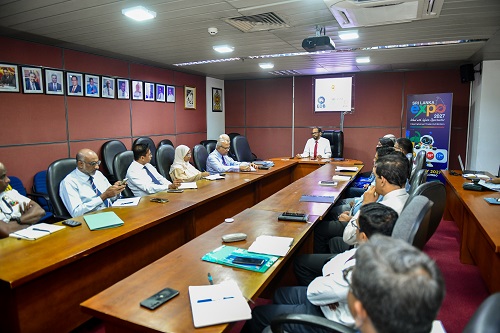
Sri Lanka is looking to expand its marine-based industries and strengthen their contribution to export earnings through improved infrastructure, investment promotion and closer public-private sector collaboration, following the establishment of a new industry advisory committee by the Export Development Board (EDB).
The inaugural meeting of the Advisory Committee on Marine-Based Industries, held on November 16 at the EDB, brought together public and private sector representatives to identify industry constraints and explore opportunities to position Sri Lanka as a regional hub for marine-based services.
The initiative comes amid growing recognition of the country's potential to leverage its strategic maritime location and expand economic activities linked to shipbuilding, ship repair, boat manufacturing, vessel conversion and marine tourism.
The meeting appointed Kaushal Rajapaksha as Chairman of the Marine-Based Services Advisory Committee and Ricky Barnett as Co-Chairman.
EDB Chairman, who delivered the main presentation, outlined the sector's current position, emerging international opportunities and the strategic interventions required to improve competitiveness and attract investment.
A major constraint identified by industry representatives was the shortage of suitable industrial space and infrastructure, particularly within the Colombo Port, for expanding shipbuilding, ship repair and vessel conversion operations.
The limited availability of facilities for fabrication, vessel construction, assembly, storage, equipment installation and sea trials was highlighted as an impediment to industry expansion. The committee stressed the need to identify alternative locations and develop dedicated industrial facilities to accommodate future demand.
Marine infrastructure development was another key priority, with discussions focusing on the potential to establish marinas, sheltered anchorages, breakwaters and boatyards to support marine tourism and recreational boating.
The development of existing harbours, including Galle and other coastal locations, into marine tourism and boating hubs was also explored. Progress on the proposed Kapparathota Marina Development Project featured in the discussions.
The committee also examined taxation and Harmonised System (HS) Code classification issues affecting locally manufactured commercial boats supplied to domestic tourism operators, highlighting the need for a regulatory and fiscal framework that supports local manufacturing and investment.
To address the industry's diverse requirements, the establishment of specialised subcommittees covering boat building and manufacturing, shipbuilding and repair, regulatory affairs, skills development, export promotion, nautical and marine tourism, and offshore services was proposed.
These groups are expected to develop practical recommendations and identify interventions to address sector-specific constraints.
The committee also identified Sri Lanka Expo 2027 as an opportunity to showcase the country's marine industry capabilities, promote investment-ready projects and establish connections with international buyers and investors.
The initiative is expected to be aligned with the National Export Development Plan 2026–2030, with stronger coordination among government institutions and industry stakeholders considered essential to achieving the sector's growth objectives.
Committee Chairman Rajapaksha stressed the importance of collective action to unlock the industry's potential, while members called for continuous engagement with businesses to ensure that recommendations translate into practical outcomes.
The establishment of the committee marks an effort to broaden Sri Lanka's export base by developing marine-related manufacturing and services, while creating opportunities for investment, employment, technology transfer and higher-value economic activity.
Subscribe to our newsletter to get notification about new updates, information, etc..
