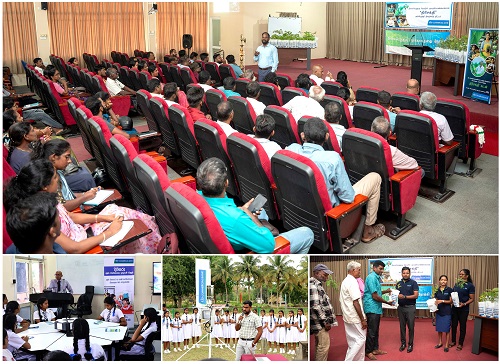
The Commercial Bank of Ceylon has launched a climate-resilience initiative to help Sri Lanka’s farming community prepare for the potential impacts of the 2026 El Niño weather pattern, bringing together universities, government agricultural officials, technology providers and farmers.
The initiative, conducted through the Bank’s Development Credit Department in September, reached more than 1,100 farmers across 15 locations with the support of 12 branches. It aims to encourage early climate-risk management rather than relying on remedial measures after agricultural losses occur.
The programme comprised two complementary interventions conducted in collaboration with the University of Jaffna and Rajarata University. The first, held in Kilinochchi, focused on climate awareness and agricultural risk management, while the second, at the Faculty of Agriculture of Rajarata University, introduced technology-based approaches to improving climate resilience.
The Kilinochchi programme brought together around 100 participants at the District Secretariat’s Skill Development Hall. Sessions led by University of Jaffna academics and a technology-sector representative covered practical measures to protect crop yields against climate variability.
The Rajarata University programme focused on Internet of Things (IoT)-based weather monitoring and the use of localised climate data to support farming decisions. Its 100 participants included young farmers, agriculture and biosystems technology students, school leavers and agricultural instructors.
The workshops addressed crop and water management, including adjusting planting schedules, selecting drought-tolerant varieties and improving irrigation efficiency. Participants were also introduced to soil and moisture conservation practices and the use of real-time weather information to guide agricultural planning.
The programmes were conducted against the backdrop of concerns over the potential effects of El Niño on rainfall, water availability and agricultural production. The Bank cited climate risks as a growing concern for farming communities, with crop losses and higher production costs potentially affecting farmers’ livelihoods and their ability to meet financial obligations.
Commercial Bank said the initiative reflects its recognition that agricultural resilience requires coordination between scientific research, extension services, digital technology and financial support. By linking climate knowledge with access to finance, the Bank aims to help farming enterprises incorporate risk management into investment decisions, supported where appropriate by tailored lending, leasing and green-finance solutions.
The multi-regional initiative covered agricultural communities in several parts of the country, including Kilinochchi, Mullaitivu, Vavuniya, Mannar, Monaragala, Nuwara Eliya, Galle, Kalutara and Puttalam districts.
The Bank said it expects the programme to strengthen cooperation between research institutions, agricultural extension services, technology providers and financial institutions, helping farmers adopt more informed, productive and sustainable practices in response to changing climate conditions.
Subscribe to our newsletter to get notification about new updates, information, etc..
