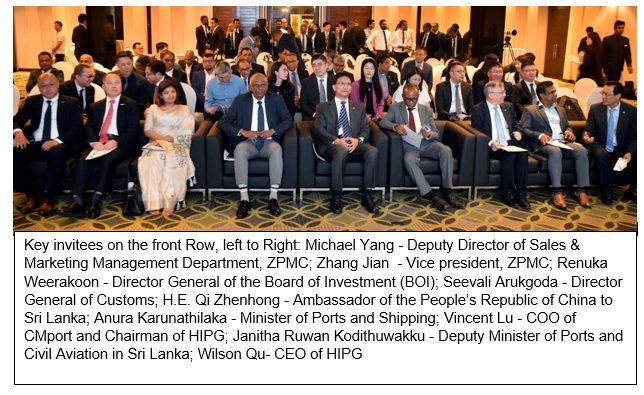
Hambantota International Port is set to significantly expand its container handling capacity with a $108 million investment in new port equipment, a move aimed at strengthening Sri Lanka’s ambitions to emerge as a key logistics hub in the Indian Ocean.
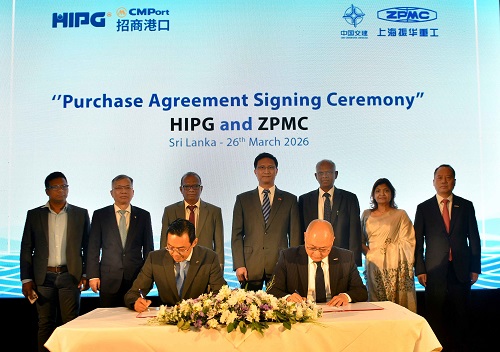
The investment follows an agreement between Hambantota International Port Group (HIPG) and Shanghai Zhenhua Heavy Industries Company Limited (ZPMC) to procure six quay cranes, 16 rubber-tyred gantry cranes (RTGs) and 40 trailers under the initial phase of the port’s Phase II container terminal development. The agreement was signed at a ceremony held in Colombo on March 26.
Once deployed, the equipment will activate the port’s existing 1,300-metre container berth and lift the terminal’s annual handling capacity to about 2 million twenty-foot equivalent units (TEUs). The new quay cranes, featuring a 72-metre outreach, 55-metre lifting height and a 65-ton lifting capacity, will enable the port to accommodate some of the world’s largest container vessels. The RTGs are also expected to improve yard efficiency while supporting a gradual transition towards electrified operations.
The expansion comes amid shifting global shipping patterns and heightened geopolitical tensions in the Middle East, which have encouraged shipping lines to seek alternative logistics hubs along major maritime routes. Hambantota’s location, about 10 nautical miles from the main East–West shipping lane, is viewed as a strategic advantage that allows vessels to minimise route deviations.
Speaking at the event, Qi Zhenhong, Ambassador of the People's Republic of China to Sri Lanka, said the project represented a significant milestone in bilateral port cooperation and reflected the two countries’ shared commitment to joint development under the Belt and Road Initiative.
Minister of Ports and Shipping Anura Karunathilaka said Sri Lanka aims to develop beyond a traditional transhipment hub into a comprehensive maritime services centre offering bunkering, ship repairs, crew changes and logistics support.
“Sri Lanka stands ready to welcome investments as companies diversify supply chains and relocate strategic operations,” he said, noting that expanding industrial zones and improved connectivity would support the country’s ambition to become a regional hub for logistics and value-added manufacturing.
The latest investment also reinforces cooperation between Sri Lanka and China while positioning Hambantota Port to complement the operations of the Port of Colombo within the country’s broader maritime strategy.
Hambantota Port has recorded strong growth across several operational segments in recent years. Cargo volumes reached 8.24 million tonnes in 2025, compared with 3.0 million tonnes in 2024, while roll-on/roll-off vehicle handling rose to 726,153 units from 579,362 units a year earlier. Container throughput climbed sharply to 428,036 TEUs from 53,169 TEUs in 2024.
Port officials say the rapid growth underscores Hambantota’s increasing role as a regional transhipment platform. The port’s development strategy also includes expanding its industrial park, where the first manufacturing facility has already begun operations.
In addition to boosting capacity, the new equipment will support environmental objectives through the gradual adoption of electric RTGs, contributing to national sustainability initiatives including the Government’s “Clean Sri Lanka” programme.
With continued government support and international partnerships, Hambantota International Port is positioning itself as a strategically important logistics and maritime services hub in the Indian Ocean, capable of meeting rising demand in global shipping.
Subscribe to our newsletter to get notification about new updates, information, etc..
